&
HISTORY
of the
VOLUNTEER INFANTRY
R.I.D.M.


the First Soldiers of Rhode Island
To Respond to President Lincoln's Call
To Defend the Nation
 |
 |
 |
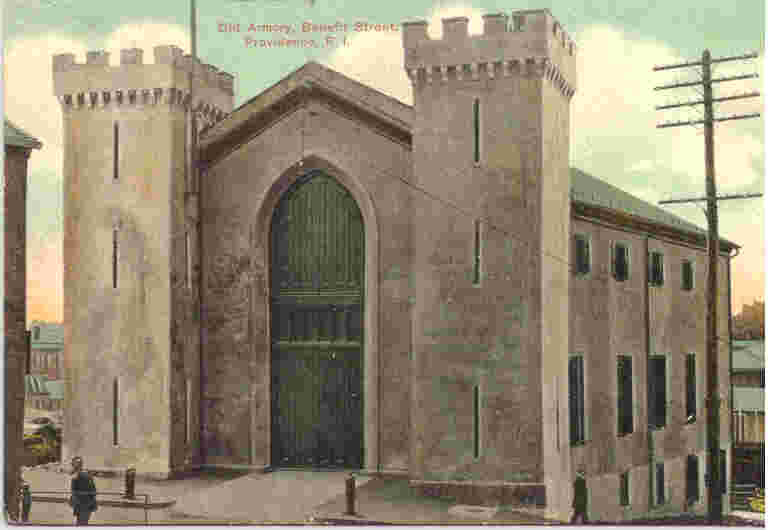
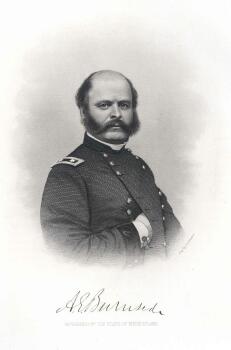
The photographs above left to right show a post card of the "Old Arsenal" on benefit Street in Providence, R.I.; in the middle Major General (later US Senator and Governor)Ambrose (Amby) Everett Burnside of Rhode Island; on the right shows down town Providence at Exchange Place (view from the hights of the Providence east side) taken across the Providence River, not far from the Old Arsenal off Angel and Waterman Streets and Benefit Street. The photo shows the fanfare of the occasion when the First R.I. Volunteers or first detachment along with the Burnside Carboneers and lead by Burnside departing in parade formation to Washington City. |
 |
 |
|
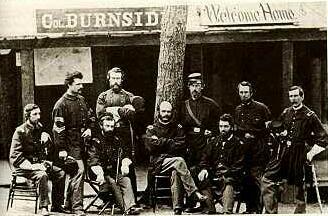
Headquarters Officers of the RI Brigade and 1st RIVI from Left to Right: |

The First Rhode Island Leaders in the War
BURNSIDE |
After the South Carolina State Militia defiantly violated the United States Constitution and fired on the small Federal Garrison at Fort Sumter in Charleston Harbor, followed by the secession of the Southern States, in an emergency response to such large scale acts of treason and armed insurrection against the Federal Government, President Abraham Lincoln called upon all Northern States to muster 75,000 volunteer troops to put down the rebellion. In response to the President’s call Rhode Island Governor William Sprague issued an order for the immediate muster of the Rhode Island Brigade. When completed, the Brigade would consist of the First Regiment Rhode Island Volunteer Infantry, the First Rhode Island Volunteer Light Artillery Battery the Second Regiment Rhode Island Volunteer Infantry, and the Second Rhode Island Volunteer Light Artillery Battery Battery A, to be followed later by the formation of a regiment of Cavalry. Ambrose E. Burnside was appointed R.I. State Militia Colonel to command the First Detachment of the First Rhode Island Volunteers-R.I. Detached Militia and the Brigade. Burnside was widely considered to be the most highly skilled and combat experienced military officer of the State. Under Burnside, the first detachment of the 1st RIVI left Providence, Rhode Island on April 19, 1861, amid great patriotic fanfare and celebration. The Second Detachment of the 1st RIVI left Providence the following day on April 20th commanded by Lt. Col. Joseph S. Pitman, R.I.D.M., followed by the 1st RI Light Artillery battery under the command of Captain Charles Tompkins. Upon their departure the 2nd RIVI and the 2nd RI Light Artillery Battery formed at Dexter Field in Providence scheduled to join the Brigade when fully mustered. Each send off was celebrated with great fanfare and festivity. Burnside also took two companies of the Burnside Carbineers (a Zuave Unit) as sharpshooters to accompany the First Regiment. The Burnside Carboneers were under the command of Captain Francis W. Goddard. The Carbineers were armed with the deadly Burnside Carbine lever action fast firing breach loader. Rhode Island Regiments were regarded among the best State troops send to defend Washington D.C. |
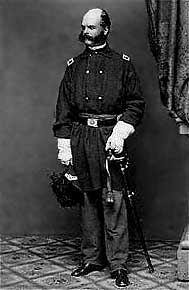
Early war time photograph |
|
NOTE: The picture above of Col. Burnside, shows him dressed in his famous "Bibbed Front" blue flannel officers-style Burnside Blouse, a fatigue tunic he designed for all the R.I. troops of the R.I. State Militia. Enlisted men wore a 3 button pull-over version. The unique blouse was primarily manufactured by the Sprague Mills in Cranston, R.I., owned by Governor William Sprague. Rhode Island servicemen preferred the Burnside Blouse over the standard issue Federal Uniform Frock or shell coat and Fatigue Jacket because of its comfort. Confederate soldiers throughout the war could always tell they were up against Rhode Islanders from a distance away, because of the distinct difference of the Burnside Blouse and Rhode Islanders were the only Union Units who carried red bed rolls slung over their shoulders or affixed to their knapsacks. A little more than 23,000 Rhode Islanders served in the war and over 1,700 lost their lives in the bloody agony of the 4 and 1/2 year American Tragedy--The Civil War. Click HERE for the Rhode Island's Own Biography of Ambrose Everett Burnside. |
|
After the defeat of the Union Army at the First Battle of Bull Run in July 1861, a great number of the men who enlisted in the First R.I. went on to re-enlist after as 3 year Union Volunteers in other Rhode Island units. When the 1st RIVI arrived in Washington it qucickly became apparent the war might last longer than 90 days. Therefore, as new units were formed after the 1st RIVI to prosecute full-scale war most were mustered for 3 years of service. Several men of the 1st Brigade and the 1st Infantry became officers and NCOs in other R.I. units formed later. Throughout the later 19th Century they were among some of the most prominent Rhode Islanders and leaders of the R.I. GAR. Prior to the Civil War, Burnside a veteran of the War with Mexico and the Apache Wars, was regarded by West Point and the War department as one of the top 10 most experienced military minds in the America, north and south. In April 1861, the mood in Rhode Island was jubilant. Most Rhode Islanders wanted revenge against the South Carolina State Militia under P. G. T. Beauregard who had fired on the Dear Old American Stars and Stripes or then known as the Flag of Columbia in armed rebellion against the Federal Government at Fort Sumter in Charleston harbor on April 12, 1861. A day after the fall of Fort Sumter, when the President issued his call for all loyal American Citizens to defend the Union Burnside returned to Rhode Island to organize the RI State Militia. They were the first volunteers to form a Grand Army to defend the Republic. Its first mission would be to protect the Nation's Capitol then act in a manner similar to US Marshals and move in to all the rebellious Southern States to restore law and order. Southerners were expected to resist. Burnside knew that meant all out full scale Civil War so he prepared the troops of "Little Rhodey" very well for the coming fight. During the First Battle of Bull Run, Commander of the Union Army 2nd Division, Brigadier General david Hunter was wounded and taken from the field. His words to Burnside were, "I leave the matter in your capable hands". See more about Burnside by clicking to "Rhode Island's Own" and on the next page of this website. |
|
| Major John S. Slocum Promoted to Colonel; Transfered to assume command and form the 2nd RIVI When the 1st RIVI reached Washington |
||
An active and out spoken Abolitionist and attorney, John Slocum was quite often in the public eye, becoming well known and hated by slave holders throughout the South. Because of that, he was a highly favored son of Rhode Island, destined for a bright political future. To many average Rhode Islanders, as well as those in politics, John Slocum was very well known and widely respected. A native of Bristol, he was also a well-respected veteran of the War with Mexico and a hero of the Battle of Chepultepec, serving as a lieutenant under Joseph Pitman. His men knew him as a cool headed commander under fire. Rhode Islanders knew him as a defender of the cause of the R.I. State Government during the Dorr Rebellion in Rhode Island prior to the Civil War. Slocum was also known as an officer who would relieve a tired soldier of his musket while on the march and carry it for him. His men loved him as one who would also share his canteen with even the lowliest private who was in need of refreshment. After the Civil War his comrades named GAR Post No. 10 after him (Slocum Post 10, the largest GAR Post in R.I.). Upon Burnside’s recommendation and Governor Sprague's request, Slocum returned to R.I. after he accompanied the First Regiment to Washington, to form a new Infantry Regiment, the 2nd R.I. Volunteers and take command. He gathered 5 other officers experienced officers to help him form the 2nd R.I. They were Sullivan Ballou, Frank Wheaton, Levi Tower, S. James Smith and Henry Prescott. During the First Battle of Bull all but Wheaton were killed leading the Second against the Rebels. All the soldiers around him saw Slocum urging his regiment on as he lay dieing with a joyous look of near victory on his face, never to see the disaster at Bull Run that would follow shortly after his death on the field. After the battle a band of disorderly Rebels searched the field to take his head as a victory trophy, which outraged every Rhode Islander to the degree that throughout the remainder of the Civil War, Rhode Island never had to institute a draft to fill the State’s quota of troops needed to preserve the Union. Although his body was never recovered, in tribute to Slocum, an empty grave for him marked by a beautiful monument was placed in Swan Point Cemetery in Providence. |
||
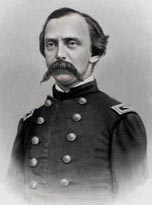
TOWER |
A native of Pawtucket, Levi Tower helped form a Rhode Island Militia unit called the Pawtucket Light Guard. A deeply religious man, Tower marched out of Providence with the 1st Regiment R.I. Volunteers on April 19, 1861, and took up quarters in defense of Washington D.C. at the outbreak of the Civil War, after Fort Sumter. As Union Troops arrived to defend the Nation’s Capitol Confederate units were so close they could set their time-pieces by the clock towers of the city. Several times while serving as Ensign with the First R.I. Tower was sent out in command of small raiding units on the Rebel side of the Potomac River to perform very dangerous reconnaissance missions in key areas along the river to dislodge the enemy or ascertain the strengths of Confederate units most threatening the Nation's Capitol. For this he drew the admiration and attention of his Commander, Colonel Burnside. |
Ensign Levi Tower |
|
Tower was greatly admired by his men. The best example of how much Tower was admired by his men was illustrated by that actions of Private Joseph Barnes of Company F, 2nd Rhode Island. A month after the battle Barnes took the entire sum of his meager funds, totalling $2.00, and went back to the battle field by way of safe passage through Rebel lines to see that his beloved Captain Tower was given a descent burial. After the war the R.I. GAR Veterans named Tower Post No. 17 in his honor. They also named R.I. GAR Smith Post No. 9 after Tower’s close comrade Capt. Samuel Smith, also killed at 1st Bull Run while leading his Company against the rebels. |
|
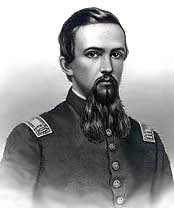
BALLOU |
A lawyer and native of Smithfield, Sullivan Ballou served 4 terms in the Rhode Island General Assembly as a State Representative. He married Miss Sarah Hart Shumway of Poughkeepsie, New York and together they had two sons. Ballou was nominated, to run on the 1860 Rhode Island Republican Ticket, for State Attorney General, but lost in the general election. Although the Republicans were winning elsewhere in the country, during the election Rhode Islanders gave a sweeping victory to the Democrats led by William Sprague's gubernatorial ticket. Governor Sprague believed the south would break from the Union well before most Rhode Islanders. He recognized the widely respected administrative talents posessed by Ballou and appointed him Judge Advocate of the R.I. State Militia just before the out break of the Civil War. Sullivan Ballou assisted Burnside in the formation of the First R.I. Volunteers and the R.I. Brigade, but stayed behind to conduct additional duties serving Governor Sprague when the First R.I. Volunteers marched off to relieve Washington D.C. after the fall of Fort Sumter. When Col. Slocum returned to Rhode Island to form the 2nd R.I. Volunteer Infantry he sought out Ballou for help. Ballou was made a Major in the 2nd R.I. Volunteers, third in command under Colonel John Stanton Slocum and Lieutenant Colonel Frank Wheaton. Ballou managed the staff of the 1st RIVI. He also made most of the arrangements for the 2nd RIVI to bivouac and train at Dexter Field in Providence. He was also legal advisor to Colonel Slocum for the acquisition of supplies and material needed to form the regiment. Since Governor Sprague, owner of A & W Sprague Textile Industries based in Cranston, was providing most of the uniforms and equipment needed, he relied on Slocum and Ballou's legal skills (both RI lawyers) to make sure the regiment received all it needed. All this ensured the 2nd RIVI was able to join the Rhode Island Brigade under Colonel Burnside in Washington D.C. and the 1st RIVI under Colonel Pitman as quickly as possible, and in time for the Union Spring Offensive against the rebels in northern Virginia. |
Major Sullivan Ballou |
|
At the First Battle of Bull Run, the 2nd R.I. moved in to action near Sudley Church. While leading his men and pressing the advance towards Mathew's Hill after crossing Sudley Springs on the rebel left flank, a Rebel cannon shell struck next to him, instantly killing his horse and ripping off his leg. His men carried him back to Sudley Church, which was converted in to a hospital, where Major Sullivan Ballou later died. A week before the battle Ballou had a vision of his death and wrote the now famous letter home to his wife Sarah. Sullivan Ballou was a loving and dear husband and a kind father. Their lives shattered, his wife and both sons mourned his death until their final days. |
|
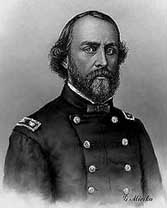
PRESCOTT Lieutenant Henry Prescott |
A native of Providence, Henry Prescott was a deeply religious man. He was also a very successful businessman with his family business in Providence prior to the war. He had absolutely no ambitions to become an officer in the State Militia or the Volunteers, but his strong leadership ability and patriotism drew him to duty. Prescott was also a well-educated man interested in English Literature, Drama, genealogy studies and he loved military spectacles. He was very proud to be able to trace his lineage to a veteran of the Battle of Bunker Hill. To his friends he quoted Shakespeare, detailed accounts of the American Revolution and the life of General Nathanael Greene. A staunch Rhode Island Patriot, he was a member of several R.I. Militia pre war units and served as a Captain of the First Light Infantry, R.I.M. Prescott was with the First R.I. Volunteers when they left Providence on April 19, 1861. Since Prescott was one of the key officers who drilled and trained the First Volunteer Regiment to the peak of their proficiency, he was selected to join Col. Slocum and help form the 2nd Regiment R.I. Volunteers. As the war began when the call came for citizens to volunteer for the First R.I. Regiment, during a dramatic militia meeting of the First Light Infantry, Henry Prescott rose to his feet first and captured everyone's attention when he said, "I offer myself to go; I feel that God calls me to his duty. I have no choice; I must go and do his will". Prescott and the First Regiment marched from the parade gathering point at Grace Church on Broad Street in Providence to downtown Providence at Exchange Place (seen in the Providence photo above). Then they marched to their embarkation area at Fox Point, Providence, Rhode Island. They boarded the steamer "Empire State" bound for New York City (the Jersey side of the Hudson) to take a train to Washington. Prescott led the First Regiment in prayer prior to boarding the steamer and wrote the following excerpt from his first letter home to his beloved family: "If you could have seen the enthusiasm at our embarkation, and after we got off; if you could have seen and heard our men, their determination the good feeling, the apparent realization of their position, the calm, noble, trusting spirit shown by most of them, you would have been proud to have me with them, as I was proud to be with them". |
After joining Slocum, on July 16,1861, Prescott marched with his new Regiment, the 2nd R.I. Volunteers across Long Bridge out of Washington with the Union Army under General McDowell to engage the enemy in Virginia. Several people from Rhode Island were witness to the grand march and followed to see the Union Army gain a great victory. Prescott and Company D camped at Fairfax. In his last letter home he wrote, "From present appearances, I shall have no moving accidents by flood or field to relate our greatest achievements being in the way of forced marches; expecting to engage the enemy, but never getting very near to them. However if the approach of our troops has the effect of making them retire, we ought to be thankful the effusion of blood is spared". During the Battle of Bull Run when all looked as though victory was imminent, Lt. Henry Prescott was shot through the forehead by a Rebel musket. At first it seemed that no one would continue to press the fight forward in his Company. As shot and shell flew around his men they all stood around Prescott stunned at the loss of their leader. Finally they regained enough of their wits to reform and continue the fight. They pressed on as far as they could loading and firing their muskets all with tears streaming down their cheeks. In March 1862, Governor Sprague and others went to the battle field to look for Prescott's body and the bodies of other Rhode Islanders. All they found of Prescott was a small piece of his tunic. A mural tablet was erected as memorial to him in Grace Church in Providence. After the war his comrades named the first GAR Post in Rhode Island in his honor, Prescott Post No.1. |
|
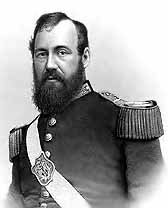
WASHINGTON D.C.
May 1861
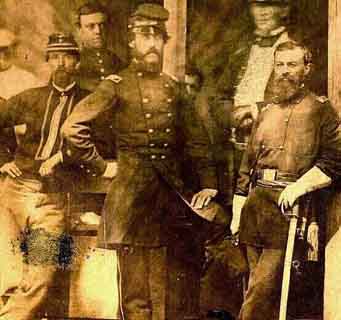
Upon Pitman's departure Balch was promoted to command the 1st RIVI
Balch led the 1st Rhodey at the 1st Battle of Bull Run.
This site is managed by: Gregg A. Mierka, Webdesigner, c/o the RI Grand Army of the Republic Civil War Museum, at 762 Dyer Avenue, Cranston, R.I. 02920.
Sources: Memoirs of Rhode Island Officers, 1868; RI GAR Encampment Proceedings 1868-1876; The 1893 R.I. Adjutant General's Report, by Elisha Dyer; All For The Union, by Robert Hunt Rhodes, 1985; and Union Blue, by Robert G. Carroon, 2001
All text on this page was authored
Thank you for stopping by our site.
CARRYING ON THE MEMORY |
 |
 |
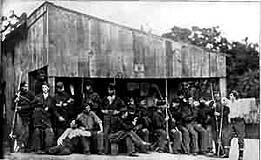 |
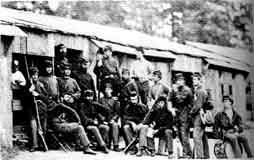
The 1st R.I. Volunteers at Camp Sprague, Washington.
The photo on the right:
The 1st R.I. Volunteers, Co.D.
We wish to thank Brother/Companion Keith G. Harrison, Past National SUVCW Commander-in-Chief and MOLLUS Webmaster, as well as all the artists/musicians for the use of their music on all the pages in our site. A special thanks also to Keith Laurent for arranging and playing Jay Ungar's Ashokan Farewell ©1983 by Swinging Door Music-BMI Used by permission. All rights reserved. |
THE CRANSTON HISTORICAL SOCIETY |
RHODE ISLAND MILITARY ORDER OF THE LOYAL LEGION OF THE UNITED STATES |
CIVIL WAR MUSEUM & LIBRARY
THE 1st RIVI HISTORY
PAGE TWO
 HERE
HERE
For the History of Battery A
(THE FIRST CAMPAIGN OF THE 2nd R. I. INFANTRY) HERE

  Get your own Free Home Page Get your own Free Home Page  
|